Topical Finasteride vs Oral Tablets: Only One Has FDA Approval
Propecia tablets have had FDA approval since 1997; topical finasteride still has none. Compare blood levels, the FDA's safety alert and the 30-day cost.
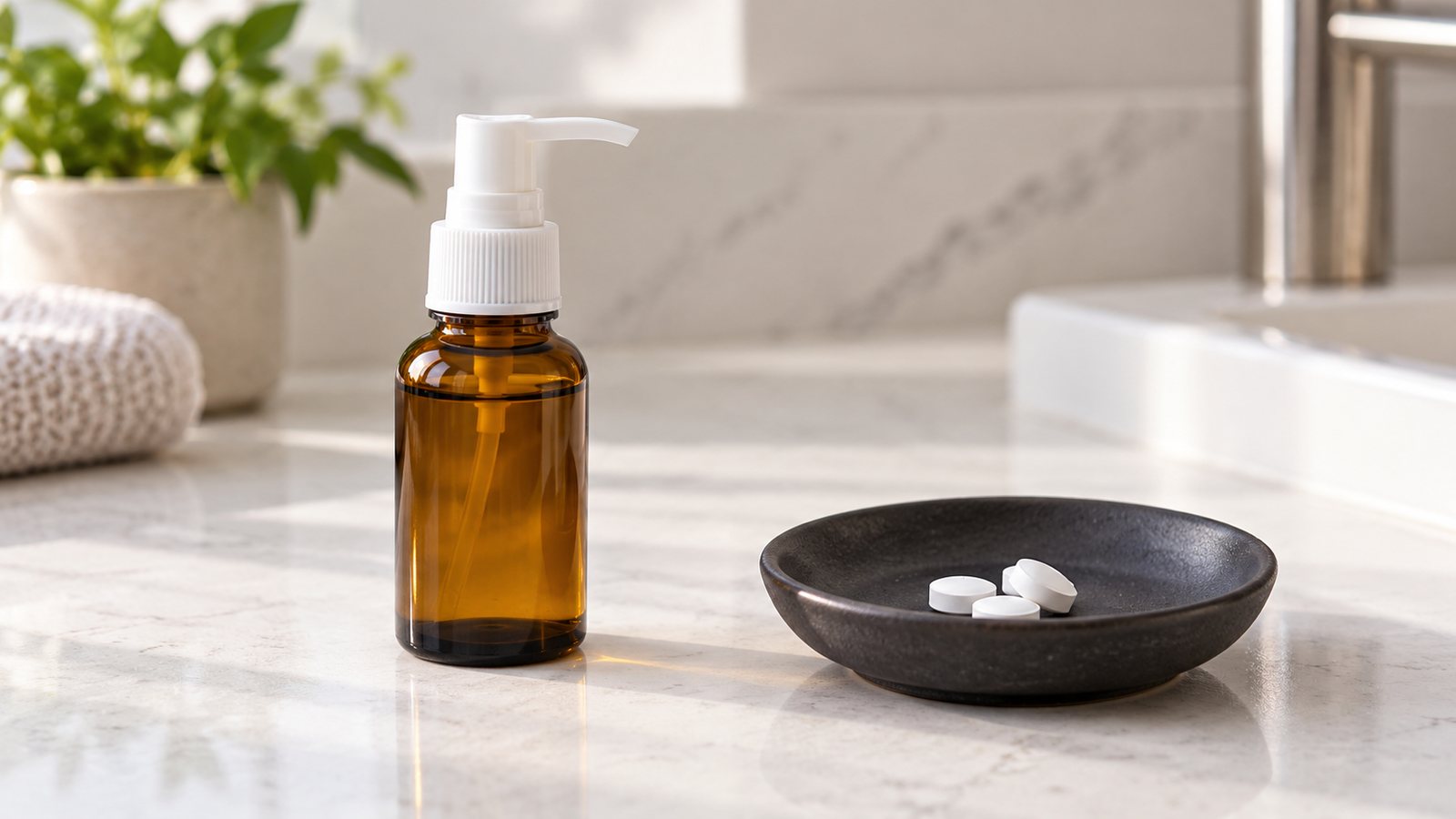
The tablet, sold as Propecia, has had FDA approval since December 19, 1997. Nearly 29 years later, topical finasteride still has none. Every other difference on this page, from blood levels to price, comes after that one.
The Topical Is the Same Drug, Put on the Scalp Instead of Swallowed
Finasteride is a prescription 5 alpha reductase inhibitor, according to the American Hair Loss Association (AHLA). In plain terms, it lowers how much testosterone the body turns into DHT (dihydrotestosterone), a hormone AHLA says plays a central role in shrinking hair follicles. The tablet carries the drug through the gut and into the bloodstream.
The topical goes on the scalp and aims the drug at the hair follicles first. AHLA notes that the approved form is the 1 mg tablet, for male pattern hair loss. Both topicals priced below mix finasteride with minoxidil.
For how the 1 mg tablet compares with the stronger one, see 5mg finasteride vs 1mg: what the dose difference means.

Only the Tablet Is FDA-Approved, and the FDA Has Flagged Topical Side Effects
The FDA says no topical formulation of finasteride is FDA-approved. Its alert covers compounded topical finasteride. Compounded means a pharmacy mixed it for a prescription; it is not a drug the FDA has approved.
The FDA counted 32 adverse event reports linked to these products. The reports reached its Adverse Event Reporting System between 2019 and 2024. A report shows what someone described, not how often it happens or proof the product caused it.
The reports described erectile dysfunction, depression, suicidal thoughts and brain fog. In most of them, symptoms continued after the person stopped using the product. The alert also lists skin reactions: irritation, redness, dryness or scaling, stinging and burning.
One risk is larger with the topical. The FDA says the tablet coating keeps the drug off the skin during normal handling, provided the tablets have not been broken or crushed. Women should not handle broken or crushed tablets, it adds, because of the risk to a pregnancy.
A topical has no coating, so the FDA warns of a greater risk to others, specifically females, through contact with the applied product.
Less Finasteride Reaches the Blood With a Topical, but Some Still Does
A phase III randomized controlled trial tested a finasteride spray against a placebo in men with male pattern hair loss. A phase III trial is a late-stage study that assigns volunteers to groups by chance. The spray was designed to act on the hair follicles and keep the amount in the rest of the body low.
The trial did not test the Hims or Happy Head mixes, which add minoxidil.
AHLA says a properly formulated topical leaves much less finasteride in the blood than the tablet, but the drug does not stay entirely in the scalp. The FDA puts it more bluntly. It expects finasteride to pass through the skin into the bloodstream.
AHLA also warns that a formula that did well in a clinical trial “cannot automatically be considered interchangeable with every compounded topical finasteride product.” So the topical’s main appeal is lower blood levels, not zero.
Hims Bases Its 3-6 Month Timeline on Oral Pill Studies, Not the Spray
The Hims spray is used once a day. Happy Head’s solution is used at 2 ml a day, split into two doses.
Hims says results from prescription finasteride are usually seen after about 3-4 months of daily use. Its 3-6 month regrowth figure carries the footnote “Based on separate individual studies of oral minoxidil and oral finasteride.” Neither figure is given for the spray alone, so plan around the longer one.
Oral vs Topical Finasteride: The Tablet Wins on Approval, Some Topicals on Blood Levels
Each cell links to its source. A cell that says “not given” is a question to ask your prescriber.
| Question | Oral tablet | Compounded topical |
|---|---|---|
| FDA status | Approved as Propecia, December 19, 1997 (FDA); 1 mg approved for male pattern hair loss (AHLA) | No FDA-approved topical exists (FDA) |
| Drug in the blood | The level the topical is compared against (AHLA) | Much less for a properly made formula, but not zero and not automatically true of every compounded product (AHLA); skin absorption expected (FDA); trial spray designed to keep it low (phase III trial) |
| Form and routine | 1 mg tablet (AHLA) | Spray once a day (Hims); solution, 2 ml a day in two doses (Happy Head) |
| Risk to others through contact | Coating keeps the drug off the skin unless tablets are broken or crushed (FDA) | No coating; greater risk of exposing others, specifically females (FDA) |
| Time to visible results | About 3-4 months for prescription finasteride; 3-6 months footnoted to oral studies (Hims) | Not given |
| 30-day price | Not given; ask your pharmacy | $75.84-$94.80 at Happy Head (worked out below); Rx hair products from $35 a month (Hims) |
Happy Head’s Topical Works Out to $75.84-$94.80 per 30 Days
Happy Head lists its 50 ml bottle at $79 for a single purchase or $63.20 on subscription (listed October 2026). At 2 ml a day, one bottle lasts 25 days. So the real cost shows up only when you scale it to 30 days.
$63.20 ÷ 25 days × 30 = $75.84 per 30 days on subscription, and $79 ÷ 25 × 30 = $94.80 for a single purchase, per Happy Head’s listing and its 2 ml daily dose.
On subscription that is about $2.53 a day. Hims lists its Rx hair products as “Starting at $35 per month” (October 2026). That is a starting price and may not be what this spray costs.
The two products have different formulas, so the prices are not a straight comparison:
| Product | Finasteride | Other actives | Use | Listed price |
|---|---|---|---|---|
| Hims spray | 0.3% | 6% minoxidil | Once a day | Rx hair products from $35 a month |
| Happy Head solution | 0.3% | 8% minoxidil, retinoic acid, hydrocortisone | 2 ml a day, twice daily | $79 single or $63.20 subscription per 25-day bottle |
Happy Head says its retinoic acid “supercharges Minoxidil” and that its hydrocortisone is aimed at irritation and redness.
For a tablet price to compare against, ask your pharmacy for a 30-day cash price on 1 mg finasteride. Then compare the same 30 days on the same billing term.
Verdict: Lower Blood Levels, Traded for a Product With No FDA Approval
- Verdict: the topical fits someone who wants finasteride with less of it in the blood and accepts two limits: no FDA approval, and lower blood levels shown only for certain formulas.
- The flaw, and its fix: the FDA’s alert lists side effects that continued after people stopped, and no FDA approval stands behind the topical. If approval matters to you, the 1 mg tablet has it. If you choose the topical, go through the FDA’s side-effect list with your prescriber first.
- Strengths: AHLA says a properly formulated topical puts much less drug in the blood than the tablet, and standardized sprays have been authorized in multiple European countries since 2020. A finasteride spray has a phase III trial behind it, though not the Hims or Happy Head mixes. You also get finasteride and minoxidil in one daily routine.
- Who should skip it: if a partner who is or could become pregnant may touch the product, skip the topical and ask about the coated tablet, kept whole. If you want no finasteride at all, see does minoxidil work: what the evidence says.
Next step: both topicals above contain minoxidil, so check its label warnings and prices in minoxidil foam 5%: how to apply it, label warnings and prices.
FAQ: Prescriptions, Regrowth and Safety
Do I need a prescription for finasteride?
Yes. AHLA describes finasteride as a prescription drug, and Hims sells its spray as an Rx product. Either way, a prescriber has to approve it first.
Does finasteride really regrow hair?
It can. AHLA says a well-made topical “can produce meaningful hair growth” and has “substantial randomized clinical trial evidence” behind it, per its topical finasteride page. No source here promises a result for any one person, and any visible change takes months.
Is the topical safer than the tablet?
Its risks are different, not absent. Some patients told the FDA their prescribers had said there was no risk “because the product was topical.” Yet the FDA expects some of the drug to reach the blood.
When to Call Your Prescriber
Talk to your prescriber before you start, and again if any symptom on the FDA’s list above appears, even after you stop. If a partner is or could become pregnant, say so: the FDA says approved finasteride must not be used in pregnancy.
This article summarizes public health sources and published studies. It is not medical advice and does not promise any result. Talk to a licensed clinician before starting or stopping finasteride.
Sources
- https://www.fda.gov/drugs/human-drug-compounding/fda-alerts-health-care-providers-compounders-and-consumers-potential-risks-associated-compounded
- https://www.americanhairloss.org/hair-loss-treatment/drug-therapy/topical-finasteride/
- https://pmc.ncbi.nlm.nih.gov/articles/PMC9297965/
- https://www.hims.com/hair-loss/topical-finasteride
- https://www.happyhead.com/products/topical-solution-finasteride-minoxidil