Why AHLA Doubts Red Light Treatment for Hair Loss – And What to Check
The American Hair Loss Association calls the evidence for red light in hair loss weak overall, with firmer trial support for FDA-cleared laser devices than for general red-light gadgets. Finding out whether it helps you takes time: one home trial used about 25 hours of sessions over 16 weeks.
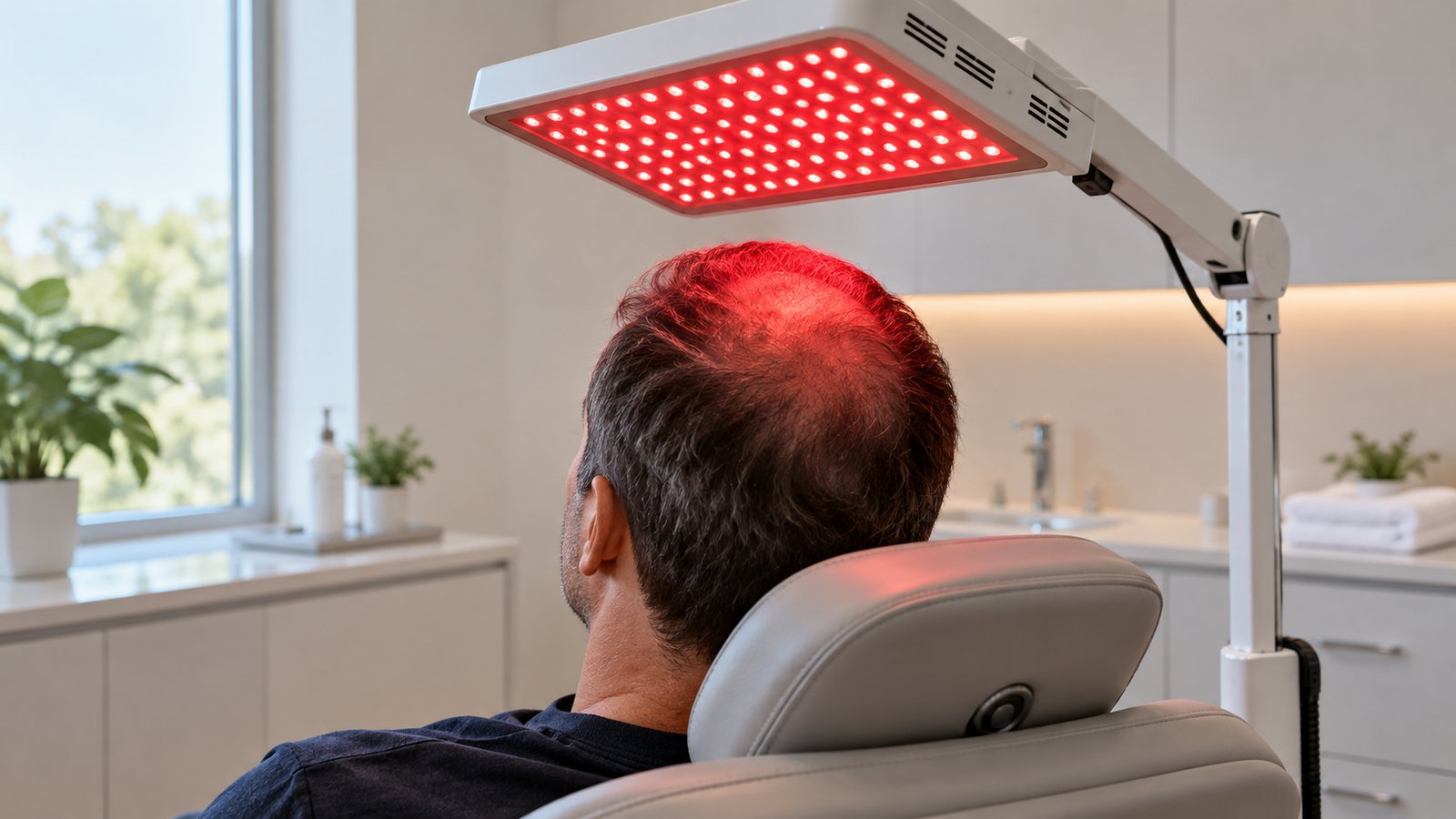
The American Hair Loss Association (AHLA) aims its doubt mostly at consumer gadgets. It calls the evidence for red light therapy in hair loss weak. It gives two reasons: most consumer red-light and LED (light-emitting diode) gadgets lack the power and targeted delivery to reach follicles, and LED light scatters.
The same page rates the evidence for laser devices cleared by the US Food and Drug Administration (FDA) as robust. It cites randomized controlled trials in men and women. Stanford Medicine also describes the evidence for hair regrowth as fairly robust. So red light treatment for hair loss comes down to two questions: which device you use, and whether you can keep using it for months.
Verdict: Weak Evidence Overall, a Firmer Case for FDA-Cleared Laser Devices
Verdict: Red light is an add-on with weak evidence overall and a stronger case for FDA-cleared laser devices. It suits someone who can keep up sessions for months.
The real flaw: the wavelength on the box can’t tell you whether enough light reaches the follicle. The International Society of Hair Restoration Surgery (ISHRS) says the hard part is getting light to receptors (molecules in cells that take in light) that can sit deep inside tissue. The fix: check for FDA clearance (the regulator’s OK to sell it), a laser source (not LEDs alone) and a stated power output (the light energy it puts out). Then look for trials on that exact device.
Strengths: the AHLA calls the evidence for laser devices robust. It cites double-blind, randomized controlled trials that found significant gains in hair counts in men and women. The ISHRS says light can also help minoxidil work better. The 16-week home trial reported no adverse events or side effects among its 42 completers.
Who should skip: you, if a device run on a schedule like the trial’s (about 94 minutes a week) won’t fit your life for at least 17 weeks. Check your own device’s schedule first, since devices differ. If it won’t fit, look at the medicines and clinician-led options in hair loss treatments compared.
See a dermatologist first if you don’t know why your hair is thinning. Hair loss has several causes, and a light device can’t tell you which one you have.
Gym Panels and Laser Caps Deliver Light Differently
Red light therapy means shining low-power red light on the scalp. In research papers the medical version is called low-level light therapy (LLLT). Devices range from LED caps and panels to helmets and caps fitted with laser diodes.
Here’s why the light source matters. Light has to pass through skin to reach the follicle, and the ISHRS calls reaching deep receptors the tricky part. For that reason the AHLA favors laser diodes over LEDs, because LED light scatters.
You’ll meet both kinds. Stanford Medicine notes that red light tools are sold online and offered in spas, gyms and dermatology clinics. A panel at the gym and an FDA-cleared cap both glow red, but by the AHLA’s standard they aren’t the same thing.

The Sources Point to Red Light Between 630 and 670 nm
Wavelength is measured in nanometers (nm). It sets the color of the light. The AHLA lists 630–670 nm with enough power output among the traits of the devices with the strongest evidence.
A laboratory study on human hair follicles narrows it further. It says earlier studies found 650 nm the most effective and practical wavelength for LLLT. That sits in the middle of the AHLA’s range, so the two sources agree.
Read the second half of the AHLA line too: enough power. A wavelength tells you the color. It doesn’t tell you how much light gets to the follicle.
A 16-Week Home Trial in Women Used 60 Sessions of 25 Minutes
The trial studied women’s scalp hair using a device with red laser and LED sources. Because it included lasers, it fits the AHLA’s advice to look for a laser source. Patients used it at home every other day for 16 weeks. That came to 60 sessions of 25 minutes each.
Forty-two patients completed it: 24 in the active group and 18 in the sham group, who used a placebo device. Comparing the two groups is what separates the light’s effect from the routine itself.
No adverse events or side effects were reported among those 42 completers over 16 weeks. That is one small, short trial, not a long-term safety record.
Small Changes at 8–12 Weeks, Clearer Change at 4–6 Months: 25 Device Hours by Week 16
The hours below are arithmetic on the trial’s schedule, not a dosing plan. Your device may run on a different one: Stanford Medicine notes that devices differ in power and in prescribed time of use.
Time cost: 60 sessions × 25 minutes = 1,500 minutes = 25 hours per 16 weeks, or about 94 minutes a week (16-week trial). The 4–6 month window for visible change (Western Reserve Dermatology) opens around week 17, one week after the trial ends.
- Before week 1. Check the device against the AHLA points: FDA clearance, a laser source (not LEDs alone), 630–670 nm and a stated power output.
- Weeks 1–7. The practice’s earliest window doesn’t open until week 8.
- Weeks 8–12. Western Reserve Dermatology says most patients notice small gains in thickness and less shedding after about 8–12 weeks of regular use. At the trial’s pace that’s 30–45 sessions, or 12.5–18.75 hours.
- Week 16. The trial ends here: 60 sessions, 1,500 minutes, 25 hours.
- Weeks 17–26 (4–6 months). The practice says more visible changes, such as new growth or clear thickening, may take 4–6 months. This window falls after the trial’s endpoint, so only the practice’s estimate covers it. At the same pace, 26 weeks comes to about 41 hours.
- If you stop. Every estimate above describes regular use. None of them describes what happens after sessions end.
The ISHRS Says Light May Help Minoxidil Work Better
The ISHRS says light therapy may help minoxidil work better. Western Reserve Dermatology cites a 2017 study in the Journal of Cosmetic and Laser Therapy that concluded low-level laser therapy can be safely combined with other hair-loss treatments.
If you’re adding medicine as well, read about finasteride 1 mg for thinning hair, and check whether early hair fall on minoxidil is the normal shed.
The Evidence Is Weak, the Mechanism Is Unclear and the Trial Had Industry Ties
- The overall verdict. The AHLA calls the evidence weak for red light in general. Laser devices are its stronger case, and results from them don’t carry over to a low-power LED panel.
- The mechanism. The lab study says researchers don’t yet clearly understand how LLLT might reduce hair loss.
- One small trial. The home trial had 42 completers, all women, followed for 16 weeks. On its own it says little about men or about longer use.
- Funding. The trial paper discloses that Apira Science funded the work. Two of its five authors report an ownership interest in Apira Science; the other three report no disclosures.
Next step: If you’re a woman weighing medicine before buying a device, read women’s hair loss: minoxidil or finasteride.
FAQ: Red Light and Thicker Hair
Can Men Use Red Light to Thicken Hair?
The AHLA points to randomized controlled trials in both men and women for FDA-cleared laser devices. The 16-week home trial covered here enrolled women only. If you’re also considering medicine, see 5 mg versus 1 mg finasteride.
Is a Spa or Gym Session the Same as a Home Laser Cap?
Not by the AHLA’s standard, which favors laser light with enough power over scattered LED light. Ask the provider for the wavelength, the power output and whether the device has FDA clearance.
How Will I Know Whether It’s Doing Anything?
Compare against where you started, at the checkpoints in the timeline above. The early signs Western Reserve Dermatology describes are less shedding and slightly thicker hair.
When to See a Dermatologist
See a dermatologist if you’ve used a device regularly for months with no change, or if anything about your hair or scalp worries you. A dermatologist can weigh red light against the medicines and procedures compared on this site.
This article summarizes published studies and public health sources for general information. It is not medical advice and does not promise any result.
Sources
- https://www.americanhairloss.org/understanding-the-differences-between-red-light-therapy-led-caps-and-low-level-light-therapy-devices-for-hair-loss/
- https://pmc.ncbi.nlm.nih.gov/articles/PMC8577899
- https://pmc.ncbi.nlm.nih.gov/articles/PMC4265291/
- https://www.westernreservedermatology.com/blogs/does-red-light-therapy-work-for-hair-loss
- https://med.stanford.edu/news/insights/2025/02/red-light-therapy-skin-hair-medical-clinics.html
- https://ishrs.org/red-light-therapy-hair-loss/